Short answer: an AI partner is an outside team that works on AI in your business over months, from finding where it helps to running it once it's live. Pick one by how they work: they should start from your workflows, talk to the people doing the job, quote fixed prices for each step, leave you owning everything and take no commissions from AI vendors. If you're under about 10 people or have one clear task a ready-made tool already does, you probably don't need one yet.
The rest of this post is the checklist I'd use if I were on the buying side.
What an AI partner actually does
A project firm builds one thing and leaves. A partner stays. In practice that means four kinds of work, usually in this order:
- Finding the work worth doing. Looking at where hours go in sales, marketing, operations and reporting, and ranking what AI can take on first.
- Building it. Usually small to start: a first-reply system for enquiries, a weekly report that builds itself, answers from your own documents.
- Looking after it. Tools change every few months. Someone has to notice when a model update breaks a workflow and fix it before your team does.
- Teaching your team. Most of the value comes from people using the systems well, which takes more than one training session.
If a firm only does the second part, it's a build vendor. That can be exactly what you need, but know which one you're buying.
When you don't need one
Plenty of businesses are better off without a partner, at least for now.
- You're small. Under about 10 people, a couple of well-chosen tools and an afternoon of setup usually beat any engagement. Start with the free two-minute readiness check.
- You have one clear, common task. If you need meeting notes or invoice reading, a ready-made product already does it. Buy the tool.
- Someone in-house can build and own it. If you have a person with the time and skill, a partner adds cost without adding much. A one-off review of their plan may still help.
- Nobody senior has time for it. A partner needs a few hours from an owner or manager each month. Without that, the work drifts and you pay for drift.
Questions to ask before you sign
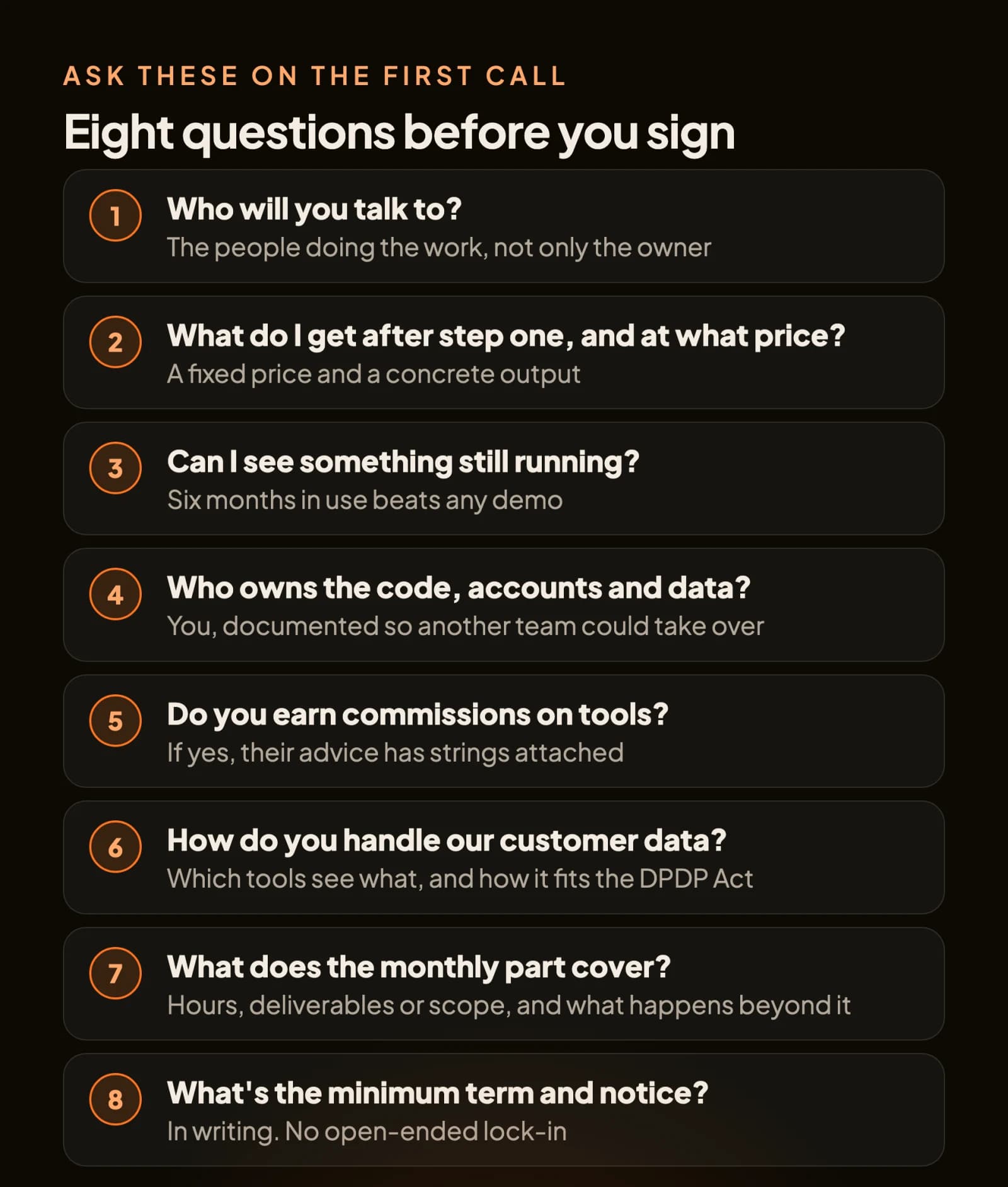
These sort the useful firms from the ones selling slide decks. Ask them on the first call.
- Who will you talk to? A good partner interviews the people who answer enquiries, chase invoices and build the reports. Talking only to the owner gives a nice plan that misses the WhatsApp follow-ups someone sends from their own phone every evening.
- What do I get at the end of the first step, and at what price? You want a fixed price and a concrete output, such as a ranked plan with effort and risk for each item.
- Can I see something you've built that's still running? A demo is easy. A system a client has used for six months, even anonymised, tells you far more.
- Who owns the code, the accounts and the data? The answer should be you. Everything should live in your accounts, documented in plain language, so another team could pick it up.
- Do you earn commissions from the tools you recommend? If yes, their advice on what to buy has strings attached. Ask before they recommend anything.
- How do you handle our customer data? They should be able to say which tools see which data, and how that fits India's DPDP Act, without reaching for a slide.
- What does the monthly part cover, and how is it priced? Hours, deliverables or scope. Each works, but you should know which one and what happens when you need more.
- What's the minimum term and the notice period? Get it in writing. A short minimum is fair for a monthly service; an open-ended lock-in is not. Ours, for reference, is six months, then month to month with 30 days' notice.
Red flags
- The tool comes before the problem. If the first meeting is about a specific AI product rather than your workflows, the answer was decided before they met you.
- Promises with numbers and no baseline. "Cut costs by 60%" means nothing until someone has measured how long the work takes today.
- No fixed price for the first step. Open-ended discovery billed by the hour tends to stay open-ended.
- You won't own what's built. Systems that only run inside the vendor's own accounts make leaving expensive.
- Everything is a custom build. Good partners tell you when an off-the-shelf tool will do.
- Nobody senior shows up after the sale. Ask who will actually work on your account, and meet them.
What it costs
Prices across the market vary a lot and many firms don't publish them, so compare what's included, not only the number.
For reference, Arthat's public prices are from ₹1,00,000 + GST for an AI Readiness Assessment (here's what an assessment covers and costs), from ₹4,00,000 + GST for a first build, and from ₹1,50,000 + GST a month for the AI Partner plan, which covers the systems we've built together, small fixes, training and the next improvements. Final prices are agreed on a free 30-minute call.
Start small, then decide
You don't have to pick a long-term partner on the first call. Start with one short, fixed-price step: an assessment or a single build. Within a few weeks you'll know whether they listen to your team, whether their estimates hold and whether the thing they built gets used. That tells you more than any proposal.
If you want to see how we run that first step, the AI Readiness Assessment page walks through it day by day.
Arthat AI
Working on something similar at your company?
Arthat AI builds these automations for Indian businesses every week. If you want to talk through whether this fits your situation, we'll give you a straight answer — even if the answer is "don't build it."