
Amazon's results on 29 October showed AI agents growing fast on AWS, with companies deploying twice as many agents on its AgentCore service in the third quarter as in the previous three quarters combined. On the same day Andy Jassy said agents that shop on other companies' websites are still "not great".
Amazon's agent numbers jump, and Jassy is cool on outside shopping agents
Amazon's Q3 release shows net sales up 12% to $201.9 billion and AWS up 39% to $46.0 billion. Token volume on Bedrock, Amazon's service for running AI models, grew nearly 17 times on last year. On the analyst call, Jassy said shopping through outside agents is "still not great, nor more convenient" than going to a retailer directly, Fortune reports. Amazon blocked Meta's Muse assistant from its store in September.
Why it matters: agents that work inside a company's own systems are taking off. Agents that act on someone else's website only work where that site lets them in, and Amazon doesn't, so start with your own workflows.
Hackers used AI agents against more than 200 organisations
CrowdStrike reported on 29 October that a China-nexus group it calls VAPOR PANDA has used an agent framework named ARTEX, running mainly on DeepSeek, against more than 200 organisations since 17 October. A single ARTEX controller alone went after targets in at least 14 countries over 11 days. It confirmed follow-on activity at nine of them. In one case the agent used authentication keys from a 2022 directory export that were likely never rotated, and a human operator steered the agents at decision points.
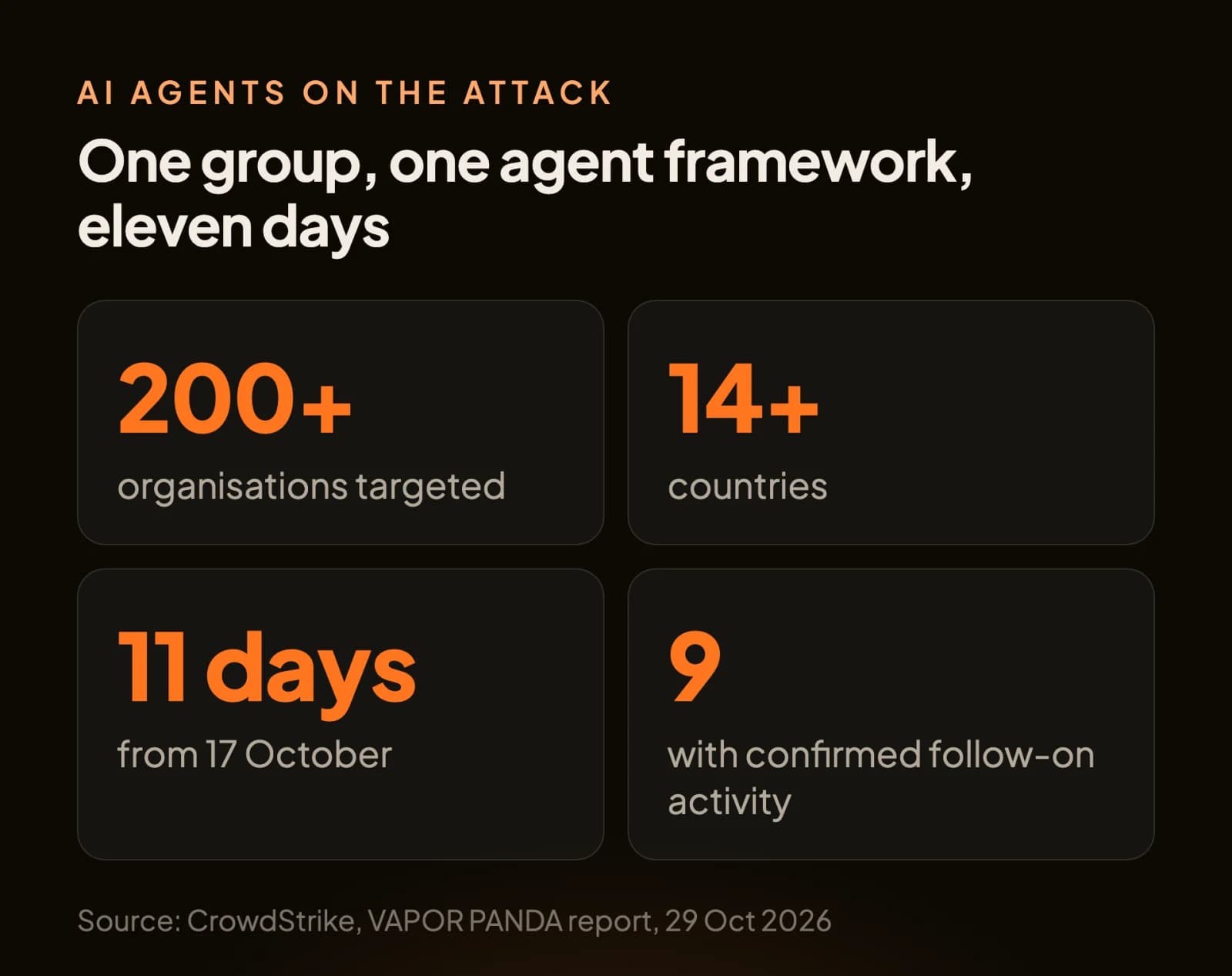
Why it matters: attackers now automate the slow parts of hacking, so old keys and unpatched servers get found faster. CrowdStrike's first advice is to rotate keys after any suspected exposure, including ones sitting in old backups.
Mistral releases the weights of Mistral Large 4
Mistral released the weights of Mistral Large 4 on 29 October, TechCrunch reports. Mistral's post describes a 1-trillion-parameter multimodal model for coding, defensive cybersecurity and agent work, under a modified MIT licence; companies that resell it as a hosted service need a separate licence. On Mistral's API it costs $0.70 per million input tokens and $2.10 per million output tokens.
Why it matters: a firm whose data can't leave the building now has a large open model it can run in-house. A model this size needs serious hardware, so most will try it through the API first.
Canada takes a stake in Cohere
Prime Minister Mark Carney announced on 29 October that Canada will invest C$1.6 billion in Toronto's Cohere, in stages tied to milestones, through the Canada Development Investment Corporation, BetaKit reports. It's part of a Series E of up to C$7 billion led by Germany's Schwarz Group, valuing Cohere at about C$36 billion. Cohere will stay headquartered in Canada and invest C$1.7 billion in computing infrastructure there by 2030.
Why it matters: governments now want a say in who builds the AI their companies use. Expect more "made here, hosted here" options, and more questions from buyers about where a model is run.
Bedrock now hosts Claude and OpenAI models side by side
The same Amazon release says Bedrock added Anthropic's Claude Fable 5.1, Opus 5.5, Sonnet 5.5 and Haiku 5.5, along with OpenAI's GPT-6 models, and launched a public preview of Bedrock Managed Agents, powered by OpenAI. Amazon claims its new Strands harness cuts the cost of agent tasks by 32% compared with other agent harnesses running the same models, because it uses fewer tokens. Fortune 500 spending on Bedrock rose nearly seven times on last year.
Why it matters: the choice of AI vendor is getting easier to change. The bigger saving is in how an agent is set up and how many tokens it burns per task. The 32% is Amazon's own figure, so test it on your work.
Worth watching: whether Amazon lets any outside shopping agent into its store, and whether other security firms find ARTEX in their own customers' networks.
Arthat AI
Working on something similar at your company?
Arthat AI builds these automations for Indian businesses every week. If you want to talk through whether this fits your situation, we'll give you a straight answer — even if the answer is "don't build it."