Microsoft and Alphabet reported quarterly results on 28 October, and both said AI demand drove their cloud businesses. Azure revenue grew 48% and Google Cloud revenue more than doubled, while Alphabet's spending on property and equipment ran past the cash its business brought in.
Microsoft's Azure grows 48%
Microsoft's results for the quarter to 30 September show revenue of $92.3 billion, up 19%, and Microsoft Cloud revenue of $63.9 billion, up 30%. Azure revenue rose 48%. Satya Nadella said the company is "helping organizations build and own their own intelligence".
Why it matters: this is where business AI actually runs, and it's growing fast. If your AI tools bill by usage, check that bill every month.
Google Cloud doubles, and spending outruns cash
Alphabet's release shows revenue up 25% to $127.6 billion and Google Cloud up 103% to $30.7 billion. Sundar Pichai said Google's own model APIs now process nearly 32 billion tokens a minute, more than four times a year ago, and the Gemini app has reached one billion users. Purchases of property and equipment were $51.4 billion for the quarter, and free cash flow was negative $9.1 billion.
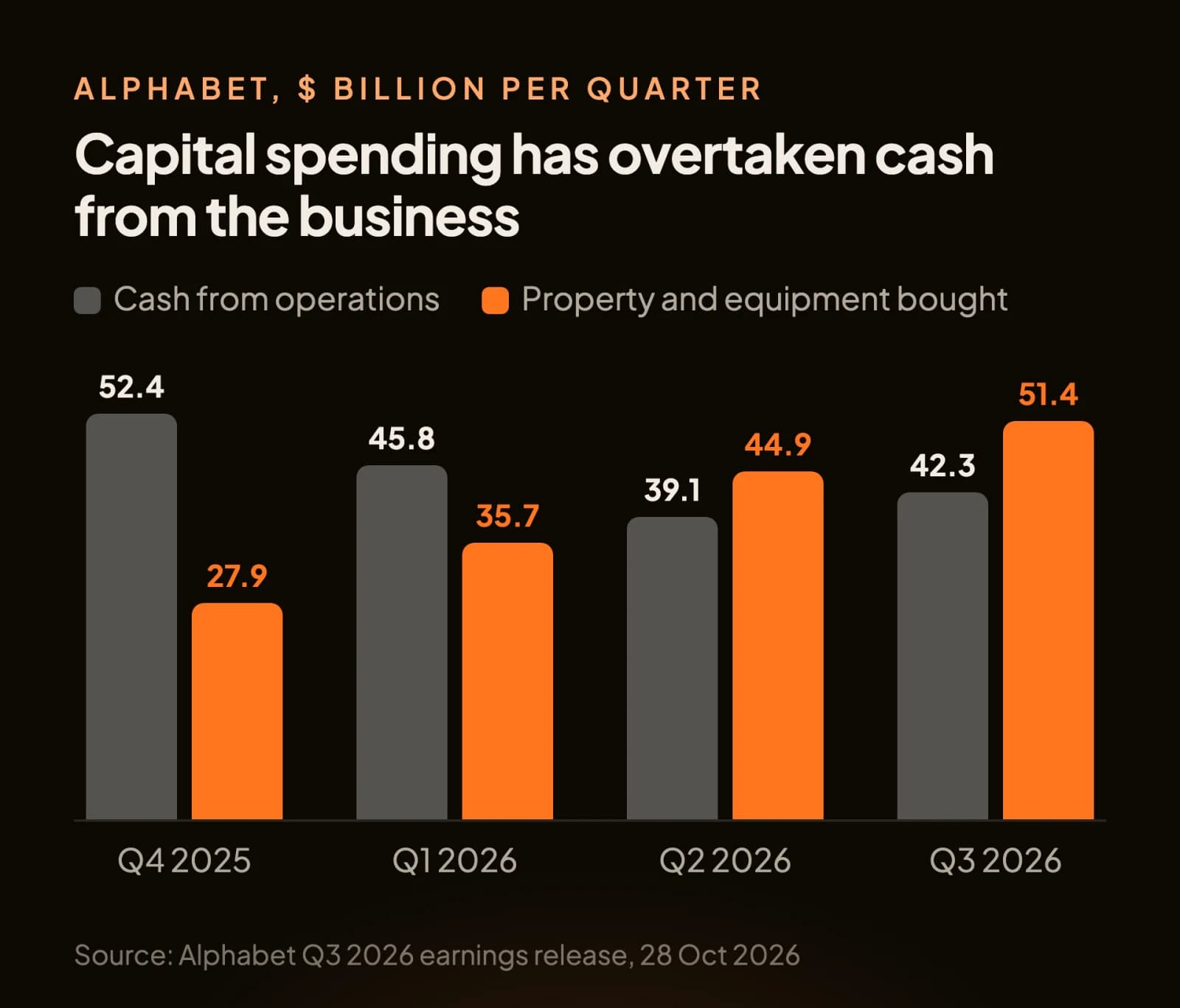
Why it matters: the API number counts developers and businesses building Gemini into their own products, and it's growing fast. Alphabet is now spending more on property and equipment than its business brings in, which only pays off if that demand keeps growing.
Sarvam will build AI for India's Army, Navy and Air Force
Bengaluru's Sarvam has signed a five-year MoU with Headquarters Integrated Defence Staff, announced on 26 October, ThePrint reports. Its defence unit, Chanakya, will build decision-support, data-fusion and training tools on Sarvam's own models, including the open Sarvam 105B, with on-premise "air-gapped" setups and human oversight kept on operational decisions. Financial terms and timelines weren't disclosed.
Why it matters: an Indian model chosen for secure defence networks makes it easier for banks, hospitals and government suppliers here to ask for AI that runs on their own servers.
New York bars some chatbot features for under-18s
Governor Hochul signed a law on 28 October that stops chatbots from offering minors features such as posing as a real human, claiming a relationship with the child, or encouraging self-harm. Companies must offer more than one way to check age, including one that doesn't depend only on a government ID, and delete the age data after use. The attorney general can seek up to $25,000 per violation, and the rules start "in the coming months".
Why it matters: if your chatbot talks to the public, make sure it never pretends to be a person. It's the first item on New York's list.
Anthropic adds ready-made legal tools to Claude
On 28 October Anthropic added a gallery of legal "artifacts" to Claude for Legal: interactive tools for cite checks, contract reviews against your standard terms, matter boards and regulatory timelines. It also added more than 60 legal connectors, including Bloomberg Law and Filevine. Each tool opens with an example so teams can see the output before adding their own data.
Why it matters: checking contracts against your own standard terms is a job many growing companies still do by hand. This is the kind of task worth testing first.
Liquid AI releases small open models that run on phones
Liquid AI released LFM3 on 27 October: six open-weight models of around 2 billion parameters, covering text, vision, audio and more, available on Hugging Face. The text model fits in about 1 GB at 4-bit precision, and Liquid benchmarked it on phones, a Raspberry Pi 5 and laptops.
Why it matters: small models like these can run on your own device, so the data never leaves the building. They're starting points that need fine-tuning for one job.
Worth watching: when New York sets the start date for its chatbot rules, and whether other states copy them.
Arthat AI
Working on something similar at your company?
Arthat AI builds these automations for Indian businesses every week. If you want to talk through whether this fits your situation, we'll give you a straight answer — even if the answer is "don't build it."