Salesforce has released SOV-Transcribe-1, a speech-to-text model whose weights anyone can download and run on their own servers under the Apache 2.0 licence. Salesforce says it ranks first among open-weight models for transcribing recordings on Artificial Analysis, and it can be told in plain language how to format what it writes.
Salesforce releases an open speech-to-text model
Salesforce's post on Hugging Face, published 12 November, describes a model with 4 billion active parameters (26 billion in total) built for recordings, not live streams. It transcribes word for word by default, changes its formatting when given plain-language instructions, and accepts keywords to boost, such as product names. Salesforce says it is #1 among open-weight models and #7 overall on Artificial Analysis for this kind of transcription (rankings as of 12 November), with a 2.28% word error rate on that benchmark. On a call-centre test covering 14 English accents, Salesforce says it had the lowest error rate of the models compared on 8 of them, Indian English among them. The post promises "best-in-class English transcription, with support for multiple languages" but does not list which languages.
Why it matters: if call recordings can't leave your servers, you now have a well-ranked option you can host yourself. Test it on your own calls, and check your languages before counting on it for anything beyond English.
Thinking Machines posts Inkling 2 Small's weights
On 9 November we noted that Inkling 2 Small's promised weights were not out yet. They are now on Thinking Machines' Hugging Face page in two versions, the main NVFP4 checkpoint and an MXFP8 build. The repositories' history shows the model files were first uploaded on 12 November (US time). The model card lists the Apache 2.0 licence, 594 billion total parameters with 17 billion active, and a context window of up to 1 million tokens.
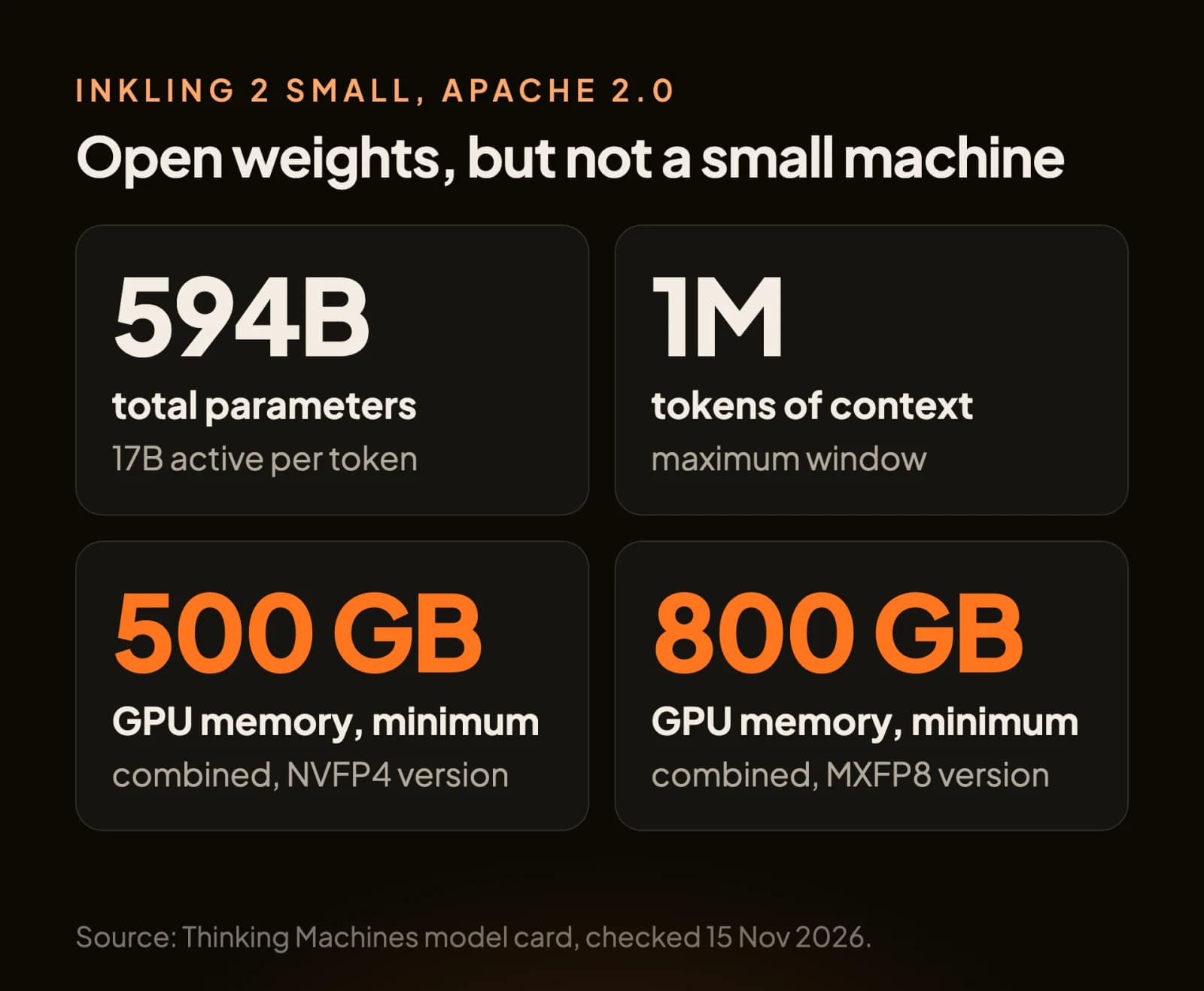
Why it matters: you can now run this model privately, but the model card says the main version needs a GPU cluster with at least 500 GB of combined memory. For most businesses, the practical route is the API access the model card also lists, through Thinking Machines' Tinker platform or third-party inference providers.
White House task force asks agencies to ease liability for companies that report incidents
In a statement after its meeting on 12 November, the Trump administration's AI task force said earlier standards for regulatory action after cyber incidents "may be outdated" and that federal agencies should "implement limitations on regulatory liability for good-faith voluntary reporting" of vulnerabilities and incidents for at least 12 months, where that is lawful and practical, with a possible extension, Cybersecurity Dive reports. National Cyber Director Sean Cairncross and Pentagon research official Emil Michael also discussed with industry a way for companies to report AI-related incidents voluntarily, with the government analysing them and sharing what it learns. This is the task force's guidance to agencies, not a new rule.
Why it matters: this is US policy and still a proposal. The idea behind it is worth copying at home: staff who report an AI mistake early, without fear of blame, help you catch it before a customer does.
Cloudflare open-sources Kitesurf, a browser engine for AI agents
Cloudflare released Kitesurf on GitHub under Apache 2.0 on 12 November, its changelog says. It runs entirely on Cloudflare Workers and can load pages, run their JavaScript and take screenshots without a browser container, and tools such as Puppeteer can connect to it through the Chrome DevTools Protocol. Cloudflare says it is "still experimental and under heavy development", needs the Workers Paid plan to run on Cloudflare, and does not provide built-in authentication.
Why it matters: teams building agents that read websites now have another open option they can inspect and run on their own Cloudflare account. Keep it to internal tests while Cloudflare calls it experimental.
Worth watching: Microsoft Ignite runs in San Francisco from 17 to 20 November.
Arthat AI
Working on something similar at your company?
Arthat AI builds these automations for Indian businesses every week. If you want to talk through whether this fits your situation, we'll give you a straight answer — even if the answer is "don't build it."