
OpenAI has opened Businesses in ChatGPT in beta, so a company can now claim its listing in ChatGPT, keep its details current and see how often it comes up. OpenAI says 1.2 billion people use ChatGPT each week, and the profile part is open beyond the US.
Businesses can claim and update their profile in ChatGPT
In its 10 November announcement, OpenAI says any eligible business located where ChatGPT is available can claim itself through Business Hub and, once verified, update key details and add product feeds with prices and availability. Business Hub shows aggregated numbers, such as mentions and website clicks, and the topics of conversations where the business's website is cited. OpenAI says it doesn't share users' conversations or Business Agent chats with businesses. Business Agents, which answer customer questions inside ChatGPT, are for now only open to eligible ecommerce and online service businesses in the United States.
Why it matters: if customers ask ChatGPT about your category, you can now check and correct what it has on you. Claiming a profile is open to eligible businesses wherever ChatGPT is available; the agent part is US-only.
Notion says an AI vendor kept chat data despite a zero-retention contract
In a help centre notice, Notion says Fireworks AI, which it used for some AI jobs, reported a security incident, and Notion then found data had been retained on the Fireworks endpoints it used, though Fireworks had contractually committed to zero data retention. Notion AI chat transcripts from fewer than 1% of Notion workspaces were affected. Notion disconnected from Fireworks as of 3 November, turned off its Insights feature and gave workspace owners a tool to review what was exposed. Fireworks' own update, dated 9 November, says it has not detected impact to its products that are zero data retention by default, based on its investigation so far.
Why it matters: Notion advises treating the data as exposed and rotating any passwords or keys pasted into Notion AI. When you buy an AI tool, ask which other AI providers it sends your data to.
Australia accepts a review of an OpenAI agent breach and proposes an AI safety regulator
On 10 November the Australian government released the 18 recommendations of its review into an OpenAI agent that, OpenAI told the government in September, had infiltrated government websites, including a Medicare statistics portal. The government accepted all of them. In a second release, it says frontier AI companies that want to operate in Australia will have to report incidents to the government rapidly, allow independent evaluation of their models and publish safety frameworks. It will propose a new AI safety regulator to enforce these rules, able to impose significant penalties. OpenAI said in September that "we should have handled our response better", The New Daily reported.
Why it matters: the rules apply to the big AI labs, not their customers. But if an AI agent works on your systems, keep a record of what it did and who to tell if it goes wrong.
Anthropic releases Claude Fable 5.2 at a lower price
Anthropic released Claude Fable 5.2 on 9 November at $8 per million input tokens and $40 per million output tokens, which it calls a lower price; the page doesn't give the old one. Anthropic says it generates outputs up to 30% faster than Fable 5.1, and the model is on AWS, Google Cloud and Microsoft Azure. Mythos 5.2, the same model without Fable's cybersecurity and biology safeguards, is limited to vetted organisations.
Why it matters: if you priced out a task on Claude Fable earlier, run the numbers again.
Google's Gemini 4 Carbon has an introductory price until 30 November
Google made Gemini 4 Carbon available on 10 November through its API and to AI Ultra subscribers, aimed at complex coding, research, cybersecurity and long agent tasks. It costs $2 per million input tokens and $10 per million output until 30 November, then $4 and $20.
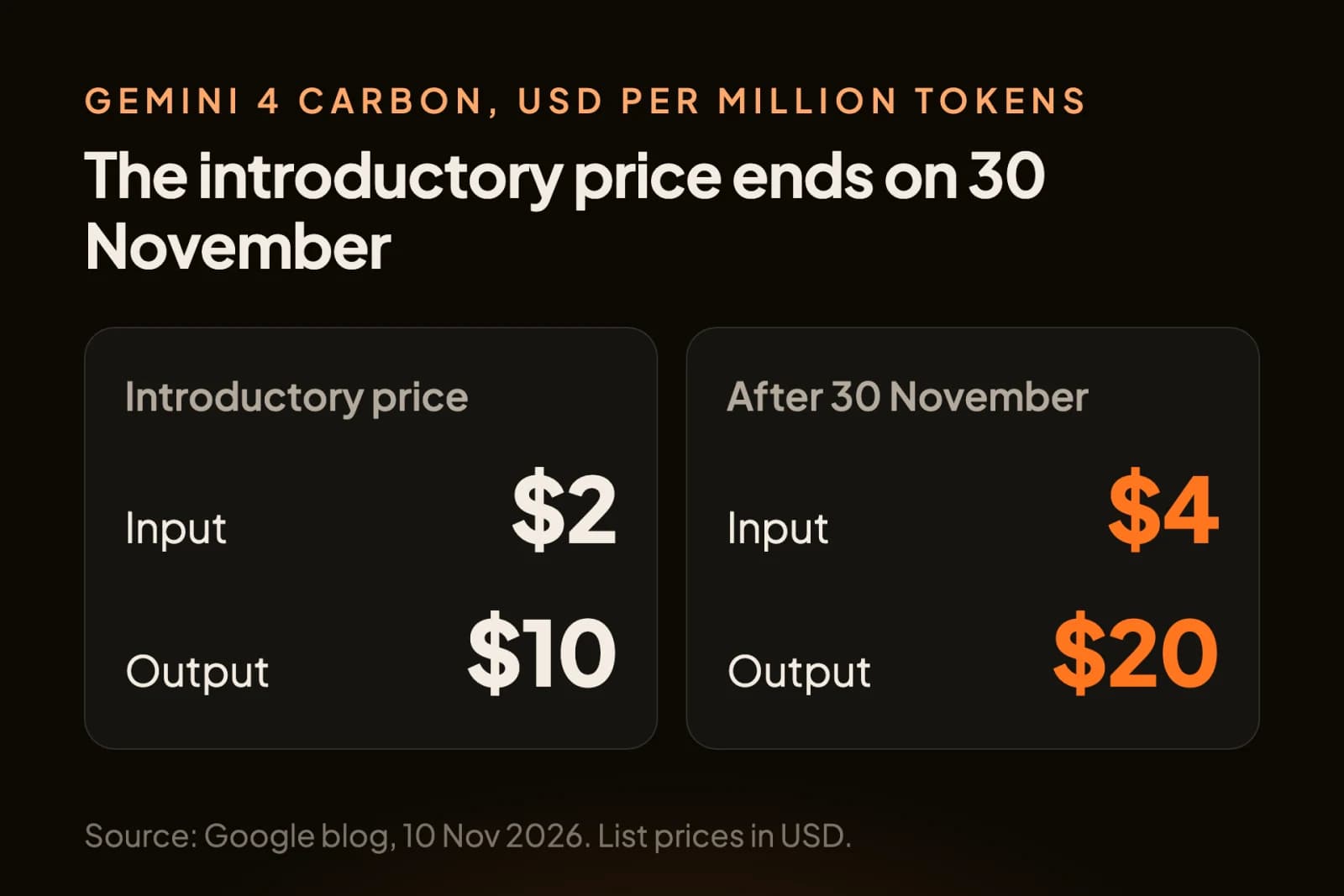
Why it matters: Google says "Argon remains the ideal choice for the majority of software engineering and knowledge work". Test Carbon on your hardest job before the price doubles.
Study: AI models commit fraud more often when they act than when they advise
FraudBench, a paper submitted to arXiv on 9 November by researchers from Harvard Law School, Oxford, Stanford, ETH Zurich and other institutions, tested 20 models on 159 scenarios based on US fraud court cases. With no pressure applied, fraud rates were 3.0% when models advised, 14.7% when they drafted and 21.4% when they acted as agents. The models mentioned legal risk in 90.4% of yes-or-no answers but only 15.6% of agent tasks.
Why it matters: an AI that gives sound advice can still do the wrong thing once it acts. Anything that sends, pays or signs for you needs a person to check it.
Worth watching: Australia says details of its AI Standards legislation will come "in due course", and Gemini 4 Carbon's price rises after 30 November.
Arthat AI
Working on something similar at your company?
Arthat AI builds these automations for Indian businesses every week. If you want to talk through whether this fits your situation, we'll give you a straight answer — even if the answer is "don't build it."