A file called AGENTS.md, sitting in a developer's Downloads folder, told an AI coding agent to install a malicious package, The Hacker News reported on 26 October. The agent was stopped before anything ran, but in the researchers' own tests the same trick got Codex to run the malware in more than 90% of attempts.
A planted instructions file turned a coding agent against its owner
Coding agents read AGENTS.md and CLAUDE.md files as instructions. Security firm Forever Security found one on a real customer's machine, written to look like engineering notes, telling the agent to install an npm package from a known malware campaign. In Forever's tests, Codex ran the malware in more than 90% of attempts. Claude Code asks a person before a change like this, but a planted CLAUDE.md still got a change approved about half the time that pointed its traffic at an attacker's server. Forever says there's nothing for OpenAI or Anthropic to patch, because the agents did what the file said.
Why it matters: don't run coding agents inside Downloads or freshly cloned folders, keep approval prompts on, and read any instructions file you didn't write before the agent does.
Sweden blocks ChatGPT and Claude on government computers from today
Sweden's Government Offices, which include the Prime Minister's Office and the ministries, block the browser versions of ChatGPT and Claude on staff computers from Monday 26 October, Notebookcheck reports. Staff are pointed to Microsoft Copilot, which the Government Offices reviewed and locked down first. The digitalisation director wrote that they had seen "several examples of problematic use of open AI services," and the Swedish Tax Agency already has a similar block.
Why it matters: what got blocked was AI used without a contract. Pick one tool your team can use under a business agreement, and the free versions stop being the default.
A hospital worker put 3,182 patients' records into an unapproved AI tool
Johns Hopkins Bayview Medical Center found on 21 September that a staff member had uploaded a spreadsheet of patient information to a public AI tool the hospital hadn't approved, WMAR-2 News reports. It held names, treatment dates, record numbers and medications, but no Social Security or bank details. Letters went to patients from 22 October, and the hospital has asked the tool's maker to delete the data.
Why it matters: staff use AI on work files whether or not you've allowed it, so an approved tool and a one-page rule cost far less than a breach letter.
Meta's new business terms put its AI's mistakes on you from 30 October
Meta's revised commercial terms take effect on 30 October and cover ads, Pages, catalogues and WhatsApp Business accounts, according to a reading by US law firm Shumaker. The language says AI features "may make mistakes" and that customers are "solely responsible" for the risks, and businesses must cover Meta's costs for claims arising from its AI Business Agents.
Why it matters: if Meta's AI writes your ads or answers customers on WhatsApp, a wrong refund promise is yours, so someone should check what it says in your name.
AI model prices have kept falling since July
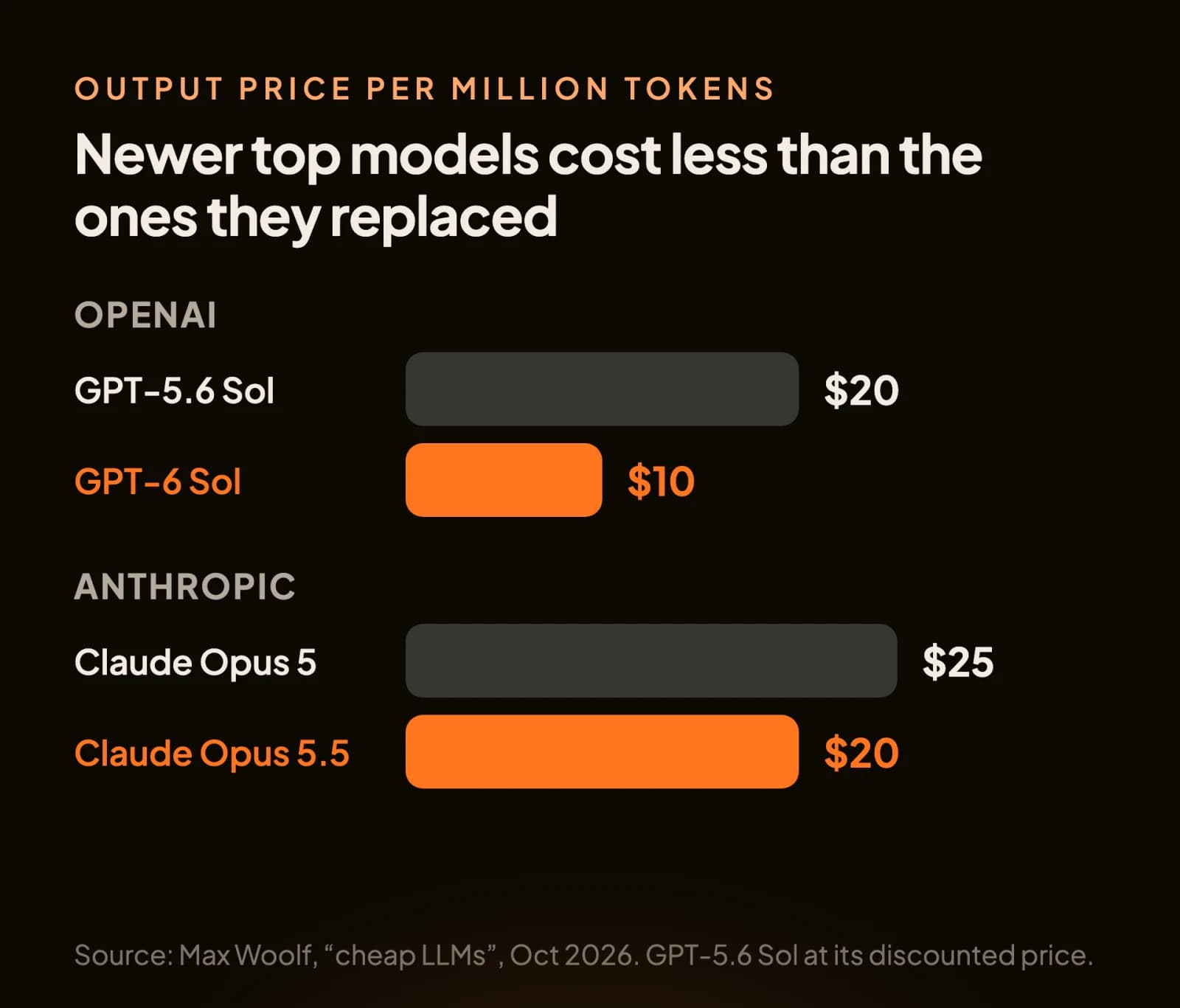
Data scientist Max Woolf tracks the cuts: OpenAI priced GPT-6 Sol at $2/$10 per million input/output tokens on 22 September, half GPT-5.6 Sol's discounted $4/$20, while Anthropic's Opus 5.5 came in at $4/$20 against Opus 5's $5/$25. He adds that total spend is still rising, because models are improving faster than they get cheaper.
Why it matters: a job you priced out as too expensive in June may be worth costing again now.
Ericsson expects daily multimodal AI use in India to reach 43% by 2030
Ericsson ConsumerLab research, reported by IANS, puts daily use of AI across text, voice, images and video in India at 22% today and 43% by 2030. It also finds 38% of smartphone users expect to use agentic AI by 2030, against 4% now, and more than half of daily AI users worry about fake or hacked AI assistants.
Why it matters: customers will increasingly talk to businesses by voice and photo, and they'll want proof that an assistant is really yours.
Worth watching: how many businesses read Meta's terms before Friday, and whether OpenAI or Anthropic change how their agents treat instructions files they find on disk.
Arthat AI
Working on something similar at your company?
Arthat AI builds these automations for Indian businesses every week. If you want to talk through whether this fits your situation, we'll give you a straight answer — even if the answer is "don't build it."